
Wheel material affects noise, wear behavior, corrosion resistance, and compatibility with the track. No material is automatically best for every door. A useful answer about stainless steel vs nylon sliding door rollers begins with the way the complete panel behaves. In a stainless steel vs nylon sliding door rollers diagnosis, the observed resistance, noise, alignment, and operation should point to a condition that can be verified.
At Sliding Doors Prime, a stainless steel vs nylon sliding door rollers complaint is evaluated across the panel and its connected hardware. Manufacturing knowledge from Mike Donovan’s 25-year career helps the team evaluate original and custom components. This Southern California guide gives owners practical observations, inspection points, and decision criteria tailored to the subject rather than a generic parts answer.
The system behind the symptom
The lower hardware carries substantial concentrated load. A small mismatch in wheel profile or housing geometry can change how that load reaches the rail. That is why experienced diagnosis begins with measurements and physical condition, not with the phrase “universal roller.”
A moving door can still contain failing hardware. A panel can glide when lifted by hand but drag again as soon as its full load returns. In this stainless steel vs nylon sliding door rollers assessment, the rail, upper guide, handle, and keeper are checked as connected components.
A door that locks only when lifted is describing a different fault from one with a broken actuator. For stainless steel vs nylon sliding door rollers, the complaint is reproduced before parts are removed and the suspected cause is then tested under controlled conditions.
What a technician should inspect
Evaluate exposure, rail material, door weight, bearing design, manufacturer intent, and the condition of the existing track.
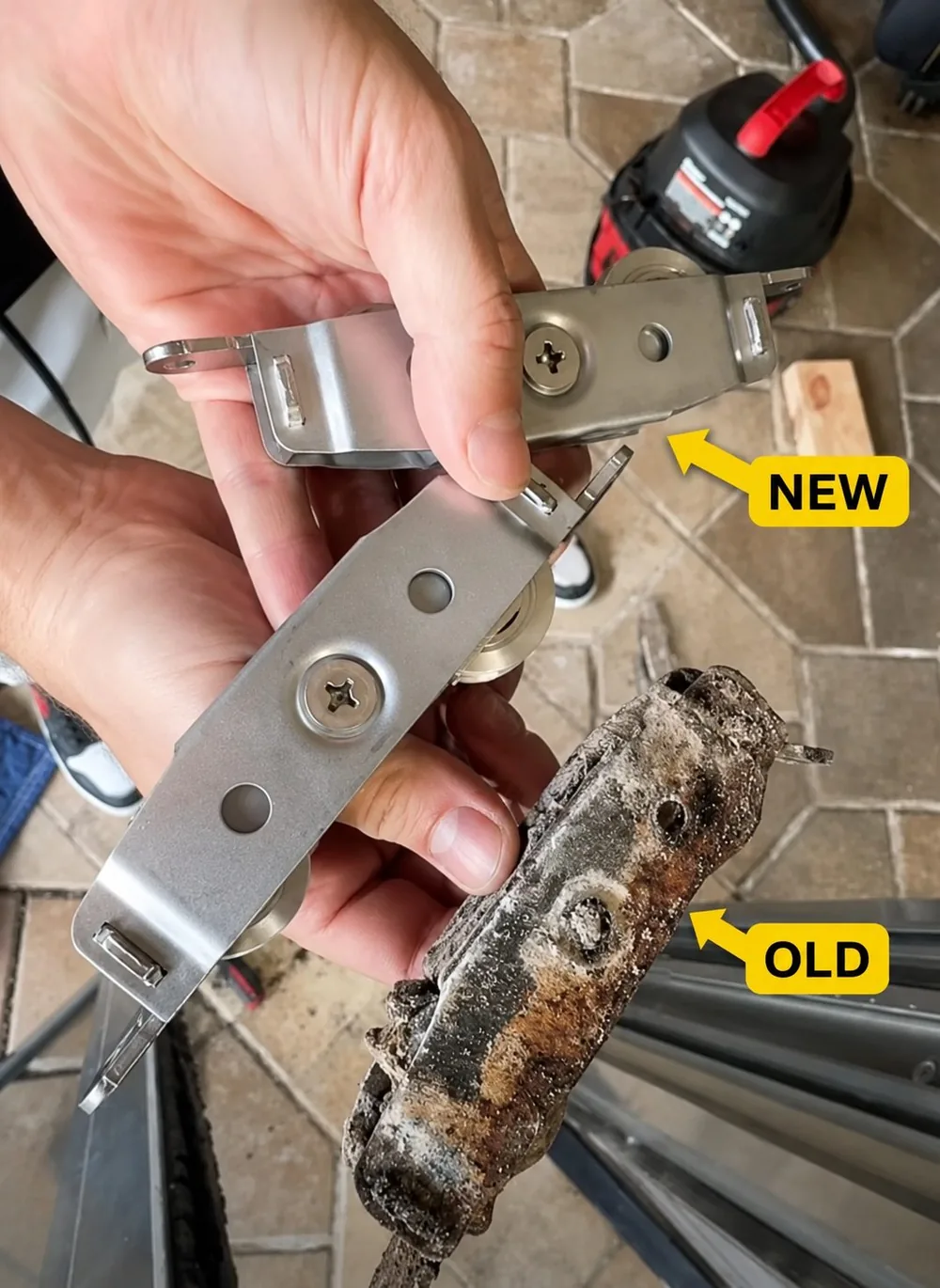
After the panel is safely controlled, the technician checks each roller for flat spots, bearing play, corrosion, and adjustment. The complete running surface is examined under load. A good repair also confirms that the lock meets the keeper without lifting or forcing the panel.
A complete inspection for this problem should include:
- Operate the panel slowly through the full opening
- Examine the rail for pits, dents, grooves, and loose areas
- Compare panel height at both lower corners
- Test roller bearings under the panel’s real load
- Measure housing, wheel, mounting, and adjustment details
- Check upper guidance, stops, retention, handle, lock, and keeper
The final explanation should identify the evidence, the affected component, and the expected result. Age alone is not a technical diagnosis for a door in Southern California.
Repair options
For stainless steel vs nylon sliding door rollers, cleaning is appropriate only when contamination is the cause and the working surfaces remain intact. Adjustment can restore geometry to serviceable hardware, but it cannot rebuild a failed bearing. Replacement becomes appropriate when the assembly can no longer carry, roll, or adjust correctly.
For this stainless steel vs nylon sliding door rollers project, rail work requires a stable supporting surface and lock work requires correct panel geometry. The sequence is chosen for the Southern California installation so one correction does not transfer the problem to another component.
Discontinued hardware makes documentation more important. For stainless steel vs nylon sliding door rollers, the removed housing, wheel geometry, mounting pattern, and adjustment direction may support an equivalent or custom solution. Manufacturing knowledge helps evaluate those possibilities before an older Southern California assembly is declared beyond repair.
Repair or replace?
The repair-or-replace decision in Southern California begins with frame integrity, glass condition, parts availability, and the owner’s performance goals.
For stainless steel vs nylon sliding door rollers, the comparison includes materials, access, finishes, approvals when applicable, energy goals, disruption, and the useful life expected from the result. The recommendation remains tied to the condition documented at the property.
Why the Los Angeles location matters
For coastal areas such as Santa Monica, Venice, Marina del Rey, and Malibu, exposure becomes part of the material decision. Inland doors may face more dust and heat. The correct component still has to match the original assembly; climate is an additional factor, not permission to improvise.
For stainless steel vs nylon sliding door rollers in Southern California, location frames the inspection without replacing it. The conditions surrounding this specific Southern California door—exposure, debris, building age, remodel history, panel size, and frequency of use—change what the technician expects to find.
What homeowners can do safely
Gentle vacuuming of loose material is reasonable when conditions are safe. Grinding, drilling, bending, or flooding unknown hardware with lubricant can complicate the eventual repair.
During a stainless steel vs nylon sliding door rollers visit, cracked glass, an unstable panel, automatic-door faults, significant ash contamination, and suspected structural damage each require precautions appropriate to the actual hazard. Written guidance cannot replace an on-site safety evaluation.
Frequently asked questions
Can stainless steel vs nylon sliding door rollers be addressed without replacing the complete door?
For stainless steel vs. nylon sliding door rollers, a targeted repair may be possible when the frame, glass, and surrounding structure remain serviceable. A stainless steel vs nylon sliding door rollers inspection and parts-compatibility check determine whether that repair can restore safe operation.
Should a Southern California owner continue using the door when this problem appears?
With a stainless steel vs nylon sliding door rollers problem in Southern California, avoid forcing a panel that grinds, jumps, tilts, or becomes unpredictable. Continued operation can enlarge related track, hardware, or alignment damage.
Can lubricant solve a worn roller problem?
Lubricant may reduce surface noise temporarily, but it cannot restore a seized bearing, flat wheel, incorrect housing, or damaged rail. Some products also attract more contamination.
Does Sliding Doors Prime serve Southern California?
Yes. Southern California is within the Greater Los Angeles service region described on this site. Availability depends on the appointment schedule and exact service address.
The Sliding Doors Prime approach
Customers seeking help with stainless steel vs nylon sliding door rollers in Southern California receive an explanation built around the installed door rather than a generic parts list. For this stainless steel vs nylon sliding door rollers topic, repair before replacement remains the preference when inspection shows that a safe and dependable repair is practical.
The final stainless steel vs nylon sliding door rollers test considers movement, guidance, closure, and locking together. On this type of Southern California door, smooth one-finger operation is memorable because correct support and security make it meaningful.
Need help with a sliding door in Southern California? Request service or call 213-297-3553.
Related pages
Technical and public references
- AmesburyTruth Roller Guide
- AmesburyTruth Sliding Rollers
- CRL Patio Door Rollers
- Prime-Line Roller Assemblies
- Doric Roller Resources
This article provides general educational information. Product selection, safety glazing, energy compliance, and permit requirements depend on the installed system, project scope, and local jurisdiction.
Need help with a sliding door in Greater Los Angeles? We answer 24/7.